DAMAC Islands 2: The Investment Case for Dubai's Most Ambitious Family Community

Atlas Research Team
Market Intelligence
There is a version of Dubai Real Estate investing that looks confident from the outside but is actually built on reputation, not data. Someone on a WhatsApp group said a developer was questionable. A friend of a friend bought somewhere else. The name didn't feel premium enough. And then there is the version institutional funds use: the spreadsheet version, the one that looks at price per square foot, yield, capital appreciation track record, community liquidity and infrastructure trajectory. The one that asks not what feels right but what the data says. DAMAC Islands 2 is a project that splits those two types of investor cleanly. This analysis is for the second type.
What DAMAC Actually Built — and Why the Market Has Consistently Misread It
To understand DAMAC Islands 2, you first need to understand why DAMAC as a developer has been systematically underestimated by a segment of the Dubai market for over a decade.
Go back to the early 2010s. Dubai was expanding rapidly. A wave of white-collar professionals, managers and corporate families was moving to the city. They were the economic engine of the emirate but they were locked in a rental cycle because the villa market was almost entirely inaccessible at the prices it was asking.
The government identified the gap and needed a developer with the scale, liquidity and execution speed to solve it. DAMAC was allocated over 50 million square feet of land to build communities like DAMAC Hills and Akoya Oxygen. The brief was specific: build fast, pack the communities with lifestyle infrastructure and keep the individual entry price within reach of a working professional.
The result was townhouses inside master-planned communities with wave pools, championship golf courses and sports infrastructure launching at AED 1 million. That was not a coincidence. That was the mandate.
What happened next is where the misreading begins. Critics looked at the finishing of a townhouse delivered at that price point and compared it to a standalone villa costing ten times as much. They concluded DAMAC was building inferior product. What they missed was that the strategy was never about the individual unit finish. It was about using high-volume, cost-efficient unit construction to keep entry tickets low while investing heavily in shared community infrastructure. The lagoons, parks, golf courses and amenities were world-class. The community itself was the product.
The consequence for early investors was significant. Low acquisition costs combined with exceptional shared amenities produced rental yields running between 7% and 8% and strong capital appreciation at handover. Communities that were once dismissed as entry-level have consistently delivered the kind of returns that buyers in more prestigious-sounding developments only hoped for.
The Corporate Structure Behind the Brand
One detail that rarely gets discussed publicly but matters significantly to understanding DAMAC's positioning is the separation of the wider group into two distinct operating models.
DAMAC Properties continues its core mission: large-scale master communities with accessible entry pricing, exceptional amenity infrastructure and strong investor returns. AHS Properties, run by Abbas Sajwani — son of DAMAC founder Hussain Sajwani — operates at the opposite end of the market entirely. AHS acquired the Shangri-La Hotel on Sheikh Zayed Road for AED 1.1 billion and is repositioning it as a hyper-luxury landmark. They acquired an unfinished building on the same road, appointed Killa Design — the architects behind the Museum of the Future — and sold it out for $600 million during construction.
This is the Volkswagen Group model applied to Real Estate. The high-volume mass-market operation funds the cash flow and community infrastructure while the luxury wing serves an entirely different buyer pool of European billionaires and family offices. By separating the brands completely, DAMAC Properties can be entirely clear about what it is and who it is building for without confusing its buyer profile with the $50 million penthouse market.
Understanding this structure removes one of the most common objections in the market. DAMAC is not trying to compete with ultra-luxury developers on the same terms. It is operating a deliberately specialised model that has consistently made it one of the most investor-friendly developers in the UAE for buyers who are not working with institutional capital.
What Happened With DAMAC Islands 1
The numbers from the first phase of DAMAC Islands are worth understanding properly because they tell us why the second phase exists.
DAMAC Islands 1 set a Guinness World Record by generating over AED 10 billion in sales in a single day. Headlines tend to treat that as a marketing achievement. The more useful reading is that thousands of individual buyers, many of them overseas investors evaluating the project on a spreadsheet rather than from local conversations, concluded simultaneously that this community solved a genuine gap in the market.
The concept was resort-style family living at a price point that had not previously existed for that lifestyle proposition. Waterfront living, crystal lagoons, beach access and a genuine lifestyle community infrastructure for families who had previously been priced out of communities offering anything close to that experience. The scale of demand was the market telling developers something important. That proposition had been underserved for years.
When a developer records that level of validated demand and has the execution track record to back it up, the natural response is to expand and evolve the concept. That is precisely what DAMAC Islands 2 represents.
The Community Concept: More Than Amenities
The approach DAMAC has taken with DAMAC Islands 2 is not to add a lagoon to an existing villa community. The entire masterplan has been constructed around the island-living proposition as its foundational concept.
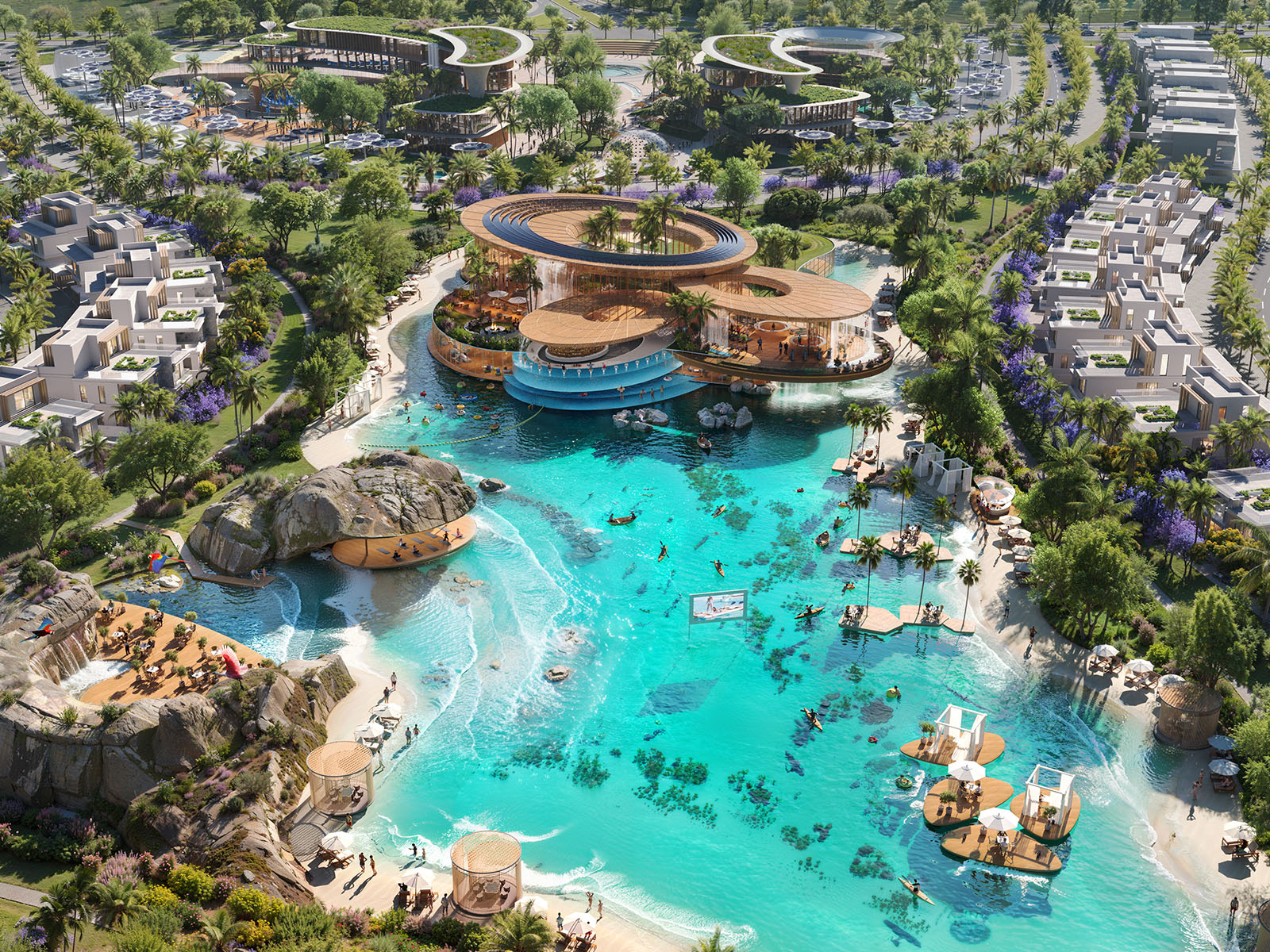
As you move through the masterplan, you encounter districts drawing inspiration from the Maldives, Bora Bora, Seychelles, Cuba, Tahiti and Barbados. Each area has been designed to carry the character, atmosphere and lifestyle feel of those destinations rather than simply borrowing the name for marketing purposes. The challenge in masterplans of this scale is avoiding repetition. Walking from one cluster to another in a conventional community often produces a monotonous experience. DAMAC's approach creates distinct lifestyle environments throughout the development while maintaining the overarching resort-living identity.
The amenity offering goes beyond what most master communities provide. Crystal lagoons, private beaches, wellness facilities, water sports, outdoor recreation spaces, dining options and family-focused experiences are distributed throughout the masterplan rather than concentrated in one clubhouse area. The depth and variety is genuinely unusual for a community at this price point.
The objective behind this approach is clear. Creating an environment where families want to spend their time inside the community rather than driving somewhere else every weekend. When residents stop leaving the community for leisure, occupancy becomes stickier, tenant retention improves and demand from new buyers strengthens. That is the reinforcing dynamic that successful lifestyle communities build over time.
Location: A Corridor That Has Already Proved Itself
DAMAC Islands 2 sits within a part of Dubai that has a documented track record rather than an emerging one. The Dubailand corridor has produced some of the emirate's most successful suburban family communities. Arabian Ranches, Al Barari, Sustainable City, Arabian Ranches 2 and Al Waha were all once considered outliers. Today they are among Dubai's most established and sought-after residential addresses, with values that have increased substantially since their launch periods.
The blueprint already exists. Families moved into the corridor because it offered more space, better value and a stronger quality of life proposition than urban alternatives. Infrastructure followed demand. Roads improved, schools established themselves, retail expanded and connectivity to the wider city strengthened. That cycle is still active and still moving in the same direction.
The most significant infrastructure development currently underway in the corridor is the Sheikh Zayed Bin Hamdan Street upgrade. The RTA has awarded a contract to increase road capacity from approximately 5,200 vehicles per hour to 14,400 vehicles per hour through new bridges, additional lanes, service roads and improved access points. Journey times through the corridor are projected to reduce significantly and the project is targeted for completion in 2028. The Al Yalayis area is also part of Dubai's wider Internal Roads Development Programme, which encompasses over 160 kilometres of new internal roads planned across the coming years.
The proposed Gold Metro Line adds a further dimension to the connectivity story. Transport investment of this nature follows validated demand rather than creating it from nothing. The reason the corridor benefits is that it has already established itself as somewhere tens of thousands of families want to live. Improved connectivity makes an already desirable location more accessible and more attractive to a wider range of buyers, tenants and investors.
This aligns directly with the Dubai 2040 Urban Master Plan, which focuses on expanding Dubai beyond its traditional core districts, creating more connected communities and improving quality of life across the emirate. The combination of existing family demand, improving infrastructure and long-term government planning vision is exactly the environment where capital appreciation in master communities has historically concentrated.
The Product: Why DAMAC Chose to Start at Four Bedrooms
One of the more considered decisions in the design of DAMAC Islands 2 is the absence of three-bedroom townhouses from the product offering. The community begins at four bedrooms, and it is worth understanding why.
Three-bedroom townhouses are frequently outgrown faster than buyers anticipate. A couple purchases a three-bedroom home with a clear plan for how they will use each room. Within a few years, a second child arrives, one parent begins working from home, family members visit more regularly and the rooms that were once available for different purposes disappear. The home that felt sufficient begins to constrain the family rather than accommodate them.
DAMAC's decision to begin at four bedrooms addresses that trajectory directly. The additional room creates flexibility that the family can deploy differently at different stages of their life. Guest accommodation, a nursery, a home office, a gym, a playroom. The important point is that the buyer is not forced to make that choice at purchase. The home adapts as circumstances do.
Four-bedroom townhouses range from approximately 2,185 square feet. Five-bedroom townhouses range from approximately 2,830 to over 3,150 square feet, and these sit on larger end-unit plots. The difference in the five-bedroom product is not simply one additional room. Larger plots provide greater privacy, more outdoor space, better natural light and a more distinct sense of separation from neighbouring homes. Combined with the larger internal floor plate, the five-bedroom units represent a meaningfully different category of family home rather than an incremental upgrade.
This product philosophy matters for long-term investment performance. Communities where the housing stock remains relevant to family needs five to ten years after handover tend to perform more consistently. Tenant retention is higher, resale demand is broader and the community is more resilient across market cycles.
Pricing: Where the Value Proposition Becomes Concrete
Four-bedroom townhouses at DAMAC Islands 2 start from under AED 3 million. Five-bedroom homes begin from approximately AED 3.6 million onwards. In price per square foot terms, that translates to approximately AED 1,250 to AED 1,600 depending on unit type, plot characteristics and position within the masterplan.
For context, these figures represent access to a resort-style masterplan lifestyle at a price point that would secure a significantly more limited product in many of Dubai's more established villa communities. The comparison with neighbouring ready communities and competing Off-Plan launches is where the value story becomes most apparent.
The payment plan structure reinforces the proposition. Buyers secure their unit with a 24% down payment, followed by predominantly 1% monthly instalments through construction alongside periodic 3% milestone payments, with 25% due at completion. For a family-focused master community of this scale, this is a manageable capital deployment profile that allows buyers to participate in the community's growth and maturation without concentrating capital risk into the construction period.
What the DAMAC Lagoons Track Record Tells Us
The objection that DAMAC Islands is simply another version of DAMAC Lagoons is worth taking seriously, because the honest answer is that it is — and that is one of the stronger arguments in its favour.
DAMAC Lagoons recorded over 1,100 secondary market transactions in 2025 alone, making it one of Dubai's most actively traded villa communities. Average rental yields have ranged between 8% and 11%. Capital appreciation across villas has averaged approximately 28%, with certain clusters such as Costa Brava and Santorini delivering returns well beyond that from a return on equity perspective. Much of this performance has occurred while the community is still progressing through phased handovers, with occupancy still building and amenities continuing to come online.
The market has already told us that families are willing to embrace resort-style living at an accessible price point. The concept has been stress-tested. What DAMAC Islands 2 brings is more water, more amenities and a more ambitious masterplan vision built on top of an already validated proposition.
Answering the Real Objections
The quality concern is the most common and the most straightforward to resolve. The appropriate due diligence is a visit, not a conversation. Walk through the show villas at DAMAC Hills or DAMAC Lagoons. Experience the communities. Look at the shared infrastructure, the landscaping, the amenities and the finished product. DAMAC has a more extensive track record of delivered communities than most developers in the market. The results are visible and accessible for inspection. Quality is not something to debate from a distance. It is something to assess in person.
The comparison with established communities is a fair question. Established communities offer certainty. You can see the finished environment and you know exactly what you are buying. The trade-off is that you are paying a meaningful premium for that certainty. DAMAC Islands 2 is a case for entering earlier in the lifecycle of a community, before the landscaping has matured, before all amenities are operational and before the corridor reaches full pricing. Historically, Dubai's strongest-performing master communities have rewarded buyers who entered before the story was obvious to everyone rather than after it was already fully reflected in pricing.
The Investment Case in Summary
The case for DAMAC Islands 2 is not built on a single catalyst. It is built on multiple fundamentals that are currently aligned.
Families in Dubai are actively seeking more functional living space and stronger lifestyle infrastructure at price points that do not require institutional wealth. The southern Dubailand corridor has already demonstrated that it is one of the emirate's most consistently in-demand family housing markets. Government and private infrastructure investment is flowing into the area at scale. The product has been designed around a buyer profile that exists in significant and growing numbers. And the underlying concept has been market-tested through DAMAC Lagoons and returned strong results across occupancy, yield and capital appreciation.
Successful master communities in Dubai have rarely emerged from a single brilliant feature. They emerge when product, pricing, location, infrastructure and end-user demand align at the same time and begin moving in the same direction. Looking at DAMAC Islands 2 today, those conditions are present.
The window in which an individual investor can access early-phase pricing in the best available projects tends to close faster than most buyers anticipate. Waiting until the investment case is fully visible to everyone typically means paying for someone else's early-entry gains.
Frequently Asked Questions
What is DAMAC Islands 2?
DAMAC Islands 2 is a large-scale master community in Dubai's Dubailand corridor offering 4 and 5-bedroom townhouses within a resort-style masterplan. The community is built around crystal lagoons, private beaches, wellness facilities and lifestyle amenities drawing inspiration from island destinations including the Maldives, Bora Bora, Seychelles, Cuba, Tahiti and Barbados.
Where is DAMAC Islands 2 located?
DAMAC Islands 2 is situated in the Dubailand corridor, one of Dubai's most established family housing markets. The location sits within a broader cluster that includes Arabian Ranches, Al Barari, Sustainable City and DAMAC Hills, and benefits from ongoing infrastructure improvements including the Sheikh Zayed Bin Hamdan Street upgrade targeted for completion in 2028.
What is the starting price for DAMAC Islands 2?
Four-bedroom townhouses at DAMAC Islands 2 start from under AED 3 million. Five-bedroom homes begin from approximately AED 3.6 million. Price per square foot ranges from approximately AED 1,250 to AED 1,600 depending on unit type and plot position.
What are the unit sizes at DAMAC Islands 2?
Four-bedroom townhouses start at approximately 2,185 square feet. Five-bedroom townhouses range from approximately 2,830 to over 3,150 square feet, with larger end-unit plots offering additional outdoor space, privacy and natural light.
What is the payment plan for DAMAC Islands 2?
Buyers secure their unit with a 24% down payment, followed by predominantly 1% monthly instalments through construction with periodic 3% milestone payments, and a final 25% due at completion. This payment structure allows for manageable capital deployment across the construction period.
Why does DAMAC Islands 2 not have 3-bedroom townhouses?
DAMAC made a deliberate decision to begin the community at four bedrooms because modern families typically require more flexibility than a three-bedroom product provides. The additional room accommodates home offices, guest accommodation, nurseries, gyms or playrooms, and allows the property to evolve as the family's circumstances change over time.
How has DAMAC Lagoons performed as a comparison reference?
DAMAC Lagoons recorded over 1,100 secondary market transactions in 2025, with rental yields averaging between 8% and 11% and capital appreciation across villas averaging approximately 28%. Certain clusters have delivered significantly stronger returns from a return on equity perspective. Much of this performance has occurred while the community is still maturing through phased handovers.
Is DAMAC a reliable developer?
DAMAC has delivered multiple large-scale master communities in Dubai including DAMAC Hills, Akoya Oxygen and DAMAC Lagoons. The group's wider structure includes AHS Properties, which operates in the ultra-luxury segment of the market, demonstrating the range and capability of the broader organisation. The most effective due diligence is visiting the completed communities and assessing the finished product directly.
Who is DAMAC Islands 2 best suited for?
DAMAC Islands 2 is best suited for medium-to-long-term investors looking for capital appreciation and strong rental demand in a family-led master community, as well as end users seeking functional family space with resort-style lifestyle amenities at a competitive price point within an established Dubai family housing corridor.
How does DAMAC Islands 2 infrastructure benefit from the Dubai 2040 plan?
The Dubai 2040 Urban Master Plan focuses on expanding the city beyond its traditional core districts, improving connectivity, supporting population growth and enhancing quality of life across all communities. The Dubailand corridor and surrounding areas feature directly within that long-term planning vision, and ongoing road, transport and community investment reflects the government's continued commitment to developing this part of the emirate.
About the author
Atlas Research Team
Market Intelligence · Atlas Advisory Real Estate
The Atlas Research Team analyses DLD transaction data, developer pipelines, and macroeconomic indicators to produce independent, data-driven insight for property investors across the UAE.
Speak with an Advisor
Have questions about this topic?
Our Advisors provide personalised briefings at no cost. No commitment required.
Request a free consultation